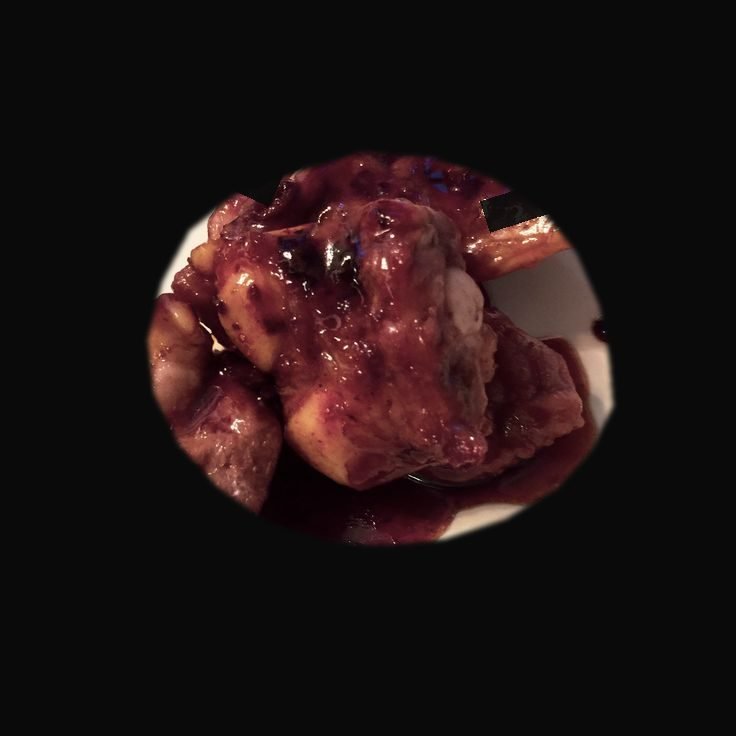
I intermittently receive queries that fall outside my remit. The current submission consists of a single photograph (Exhibit A, above · reproduced with the plate redacted by this office) and a question: but, what ends when the gristle stops throbbing? I understand the question to be posed in good faith, with apologies to Throbbing Gristle (London, 1976–1981, 2004–2010), whose name the question lifts. The photograph submitted alongside the query depicts three pieces of braised pork gristle, originally plated on a Japanese ceramic dish patterned in blue rays; I have, in the interest of focusing attention on the subject of the query, crudely obliterated the plate. The sauce is dark, glossy, and adhering. The matter is asked: what does the band's name describe, when the gristle in question is no longer throbbing? I adjudicate.
I find that the band's name describes a condition, not a substance. Throbbing gristle is a state the cartilage attains under specific circumstances; it is not the cartilage itself. The condition has, in the case before us, ceased. The gristle has been removed from the body, cut, braised in soy and sweet rice wine for a documented sufficient duration, glazed, plated, photographed, and submitted to this office. None of these stages permits the prior condition to persist. The throb has ended. What remains is the gristle, as object, in repose. The band's name, applied here, describes a state the dish no longer holds. The photograph is a photograph of former throbbing gristle. I require the distinction to hold.
What ends when the gristle stops throbbing, then, is the name's applicability to the photographed object. The band's 1976–1981 catalogue persists, unaffected. The dish on the plate is a separate matter and cannot stand as a Throbbing Gristle artefact. The matter is closed. The photograph is herewith stands as Exhibit A in an unopened mode.